Tuesday, June 12, 2012

Tanita Davis Interview ( 2012 Summer Blog Blast Tour)

Tanita Davis has been one half of the YA author blog Finding Wonderland since 2005. Her third novel, Happy Families was just released last month. Like the author's previous works, the family dynamic is well executed. I am very happy to have the opportunity to interview Tanita Davis about her latest novel for day two of 2012 SBBT


Hi. Tanita and welcome. Can you tell us a little about Happy Families?

Happy Families is a love story to families, if that’s not too abstruse. It’s about unconditional love, and going the distance in the name of love, no matter how far that takes you from what you might think everyone else is doing. It’s about fear and doing things anyway. It’s …complicated, a bit.

The cover flap tells you it’s about a set of twins who have to come to terms with their father’s new life. That’s as good a description as any.

You give a quick glimpse of Ysabel and Justin’s life before their father's secret is revealed. Did you develop the twins’ back stories more in drafting? I only ask because while the before was concise, it was still an excellent set up for the after.

Thanks. No, I didn’t write a whole bunch more backstory for the twins – it’s my own imaginary Happy Family scenario – parents who are both happy in themselves and deeply invested in the kids, kids who both have challenging and fun hobbies and are invested in each other – loving but not too much in each other’s faces. It was easy to write because it was a familiar dream. I didn’t – don’t – have that family. My people are greatly beloved, but hardly idyllic.

A little bonus fact: I wrote Ysabel’s backstory twice because originally she was in orchestra, and my editor said that there were too many YA novels with female characters who played cellos. I had no idea! (I still have no idea!) I was slightly annoyed at the time, since the cello is my Secret Longed-For Instrument (along with the balalaika and the dulcimer), but I’m just as glad now that I changed her focus, and thus changed her entire personality. Also, I got into lamp working and beads and jewelry making just from the research. Pretty much anything that lets me have even a tiny torch to begin with, and ends with jewelry? Is A Good Thing.

While the family must come to terms with the father's second identity as Christine, one thing that is never in question is their faith. I really appreciated how well the family’s faith is blended into the storyline. Why do you think religion and faith can be difficult to balance in fiction?

Well, the question is taking for granted that I do think that. I don’t. Perhaps I should clarify – maybe religion can be difficult to balance in fiction, but faith? No.

When I say “faith,” I don’t mean a kind of outward thing that people do, the denomination to which they belong, the external trappings of organized institutions. The externals are religion – what others may use to define you, or how they may wish to label/categorize you. The internal is faith.

Faith touches every part of a person’s life, so writing about it – writing from that personal context – should be the simplest balancing act in the world. (Please note the word Should!) I agree that it’s not always easy, not for everyone.

There are reasons why it’s not – in this society we so fear to offend that we’ve all made sure to homogenize so that we cannot possibly be found to be wrong or different or worse, strange. In the political arena, we’ve created offense to be an art form – just look at how many teacup tempests boil over, and how many apologies on behalf of entire peoples and nations are demanded on a weekly basis. We are locked and loaded and sometimes seem to be spoiling for a fight. The result? People take no chances, and make no waves… which creates timid, boring writers, and an eternal sameness in the fictional landscape.

We shouldn’t want to shove our faith in anyone’s faces – shoving is rude. But, when the fear of being seen as trying to proselytize – or the fear of being labeled as earnest or fanatical or tragically unhip – actually causes us to attempt to hold back or only write from our center selectively, then we’re throttling our voices, which is going to create terrible writing.

This is not to say that every novel by a person of faith must contain theological treatise. It’s just that, as Sara Zarr says, a writer writes from her or his worldview. If their worldview is centered in faith, whether culturally or spiritually, even in small ways, it will show. And, if a writer remains true to their craft, and doesn’t use their work to “send a message,” bludgeon, or berate, then the faith and the fiction will balance.

While I was reading Happy Families, I couldn't help but think that this novel will be challenged it’s only a manner of when. Is there any part of you that is looking forward to that first challenge? And have you already thought of what your response will be?

Looking forward to…? Wow, really? No. I am actually hoping that this book is not challenged maybe that makes me sound a little naïve.

While I am not a person who flees confrontation, neither am I a person who invites it. For some people, Happy Families may be topically polarizing and unbearably upsetting, I did not write with the intention of creating controversy, challenge, or discomfort to a level where people felt they had to act to protect their children. I deliberately kept the focus of the novel on the most important characters: Ysabel and Justin. This is their story.

There were so many times, during the writing of this novel, when I turned to a note I had written myself, and reminded myself of why I was doing this. There were so many times when my own fears of my own inadequacies in dealing with the subject matter just rose up to overwhelm me. And then I remembered - love is stronger than fear… and if all I was afraid of was exploring and reinforcing the idea that it’s okay to truly love, then I needed a reality check.

As to the rest – I don’t think I’m going to respond to challenges to the book. I don’t know what the etiquette is on that, but my normal conversational rules apply: if someone asks me a question that isn’t rude, I’ll answer if I choose. Otherwise, most challenges occur on a school/public librarian level, and those stalwarts will be the ones talking people through their biggest concerns. I trust that they know their patrons best, and can’t imagine me jumping in would do anything but stir the pot.

The bottom line is, concerned person has to be guided by their beliefs. If they’re of the belief that I am trying to hurt people with this novel, then I can only be sorry, but know in my heart that hurting anyone is never my intention.

I must confess to not liking the cover at first. It wasn't until after I started to read Happy Families that the cover design finally clicked for me. Giving the impression of a family existing as one unit. At least that's what I get from it, please don't burst my bubble if I am wrong. But can you tell us a little about the cover process?

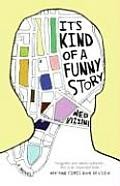
I had a chance to kind of observe the entire design process. I was even asked to submit a conceptual idea, which was a first for me. Together with the design team we came up with the little male/female pictograms. Where we went from there was all over the board. We discussed had four basic pictogram styles, one photographic cover (which was all shoes/feet), and then from there we discussed background colors, spacing, fonts – seven mock-ups later, we eventually decided that none of the designs worked for enough of us. Enter Number Seventeen Productions. They did some fun stuff with the designs for Ned Vizzini’s books (It's Kind of a Funny Story ), and I was eager to see what they had for me.

I was excited when I saw the cover – a pink pictogram with the stereotypical skirted girl figure, a blue pictogram for a stereotypical boy, overlapped… to create a purple one. And okay, your bubble can stay intact: for you, this cover is about family being a single unit.

For me, more than the obvious metaphor the figures represent, the cover hints about the self being comprised of more than we show on the surface; we identify in more ways than what we observe in others. We are both the sum of all of our parts, and more.

One thing I love about the characters you create, you never feel the need to prove their "Blackness", they simply are who they are.  Do you think your desire to simply tell great stories and not create characters that fit into a pre-assumed box has made it difficult for your work to be categorized? Or for you to find an audience?

Coe Booth was recently quoted in The Atlantic Wire’s piece, “The Ongoing Problem of Race in YA fiction” She talked about how authors of color are at times perceived to have some greater responsibility with their work, and that sometimes a book is … just a book. DEFINITELY, some people are automatically turned off by the covers of my books depicting people of color, definitely turned off by knowing that I am a person of color – there’s a lot of assumption about the types of stories a writer of color tells. However, I’m not sure it’s specifically down to not fitting into a pre-assumed box within writers of color -- it could always just be the way I write!

In grad school, an intense Latino woman cornered me one day and asked me why I wasn’t “representing” more, and really said some hard words about my community and my experience, and what I wasn’t doing right. I think of her from time to time, and hope that she understands that there’s no such thing as one experience and one community, for anyone of any gender, ethnicity, color or faith. If readers can remember that, they’ll find their choice of reading widens dramatically.

There's a real easiness to your writing that I like with the story always unfolding naturally from the dialogue to the situations. What do you think is the foundation of good writing?

Thank you. The foundation of good writing to me is intense, active listening, and close reading. The best writers have words swirling in their bloodstreams, and in their breath and bone. I encourage fledgling writers to read, read, read, and try their hand at expressing their world. Great stories flow from there.

The desire of the Nicholas family to find their happy again is something everyone can relate to. Do you think readers will be more accepting of differences after reading Happy Families?

I certainly hope so.  Ashley Hope Pérez wrote a blog essay - Happy Families is the antidote to the "I'm Christian unless"... disease, which resonated with me. She speaks eloquently on the message of this book for her, and people who were raised in conservative communities like her. She talks about the glossary in the back as kind of being the first step to an action plan – I can change the way I speak about this today. It is her belief that these faith communities will be better able to embrace this book than might be expected. I support her belief, and anticipate thoughtful action and support from those who wish to choose love over exclusion, and acceptance over mere tolerance.

Do you plan on doing any author events either in person or via Skype?

I’m currently in Scotland, and I’ve been here just shy of five years. In that time, Tech Boy has gone from Mr. to Dr. (he came to do one degree, and is leaving with two), and it’s time for us to leave. Far from being ready to “get back to normal,” whatever that is, I’m voting we go somewhere else adventurous, so stay tuned for where we end up! Meanwhile, I do Skype visits with Seton Hill University and Oakwood School almost every year. I’m interviewed by individual students and correspond with quite a few. People can contact me through my website.

I plan to be in the United States this summer, and while I haven’t got book things quite lined up just yet, keep an eye on my website and my blog – I’ll be around!

Be sure to check out the other Day 2 interviews. 

Timothy Decker @ Chasing Ray
Y.S. Lee @ The YA YA YAs

A comprehensive roundup of the tour

Monday, June 11, 2012

Nalo Hopkinson Interview (2012 Summer Blog Blast Tour)

Welcome to the first day of  2012 Summer Blog Blast Tour. This week eight bloggers will be sharing various interviews, all of which will be linked back to Chasing Ray.

Nalo Hopkinson is an award winning fantasy author, The Chaos her YA debut has received three starred reviews. I was very excited when I heard about this book back in December.  With there being so few YA fantasy authors of color, when an established one decides to write one, its a reason to cheer.
Hi Nalo and welcome. Can you tell us a little about The Chaos?
NH: Thanks for the welcome! Now, I suck at synopsizing my own work.Easiest for people to read the publisher's blurb. Basically, my protagonist, Sojourner "Scotch Bonnet" Smith, is a 16 year-old Toronto girl. Her nickname comes from the Jamaican scotch bonnet pepper, one of the hottest peppers in existence. Scotch is biracial. Her parents transferred her from one high school to another because she was being slut-shamed by the girls in her previous school. She's just broken up with her boyfriend although she still cares for him. She's also begun seeing things that no-one else can see, and there's something chasing her.

Why is Scotch self conscious about not having a Caribbean accent?
NH: Scotch's mother is black middle-class American, and her father is white working-class Jamaican. She's proud of what she is. People who have eyes to see can tell that she is black (though not everyone has eyes to see!). So she feels as though she's representing for the maternal part of her heritage. But no-one can see her Jamaicanness, i.e. her father's side of her heritage. She thinks it would be more obvious if she had a Jamaican accent. She also thinks it'd be something clear and simple that she could claim. Everything about her is so hybridized that although she's not ashamed of it, she doesn't have any easy markers of authenticity. She feels the pressure of that.

She doesn't have an easily definable identity, and that can make a person feel lost, like they don't belong anywhere, like they can't claim affiliation with any one group. Canada as a nation wrestles with what it means to be Canadian, so that comes into play a bit, too. It's most obvious in the scene in the bar where Scotch is scoffing at the MC who tries to seem more authentically black by talking in something like an American accent and by name-checking only black American musicians and musical stylings. It's a dilemma for many -- not all --young black Canadians as they try to self-define. On this continent, blackness is seen as synonymous with black Americanness. If they don't look and act like what people associate with American blackness, they get seen as weird, inauthentic.

After the Chaos everyone is changed in some way. What says more about a  person, the transformation or whether or not they are accepting of it?
I think it depends on the transformation and on the person. The woman who's now sprouting roses even though she's allergic to them might not be so sanguine about her new biology. And Scotch's change --i.e. the appearance of the creature that's stalking her -- she could be hurt.

 A rolling calf and Baba Yaga, are a part in the story. Caribbean and Russian folklore fusion was unexpected but works. Why did you decide to blend the two?
I'm glad that you think they work! I also invoked the firebird, the phoenix, the roc, the simurgh, the kappa, Anansi, Brer Rabbit, Tinkerbell, and Sasquatch. Others I just plain made up. People from the cultures all those mythologies are from live in Toronto, so it made sense to mix things up. Like Scotch's life, mine is also hybridized. It rarely makes sense for me to just pick one thing.

Beyond having an author of color pen a new YA fantasy, I was excited about your, YA debut because I knew it included a diverse cast including gay and lesbian characters. In your novels for the most part everyone is accepting of everyone else. Is this a true reflection of Canada or what you would like Canada to be?
I tried to mix it up; to show both acceptance and prejudice. Punum's dad kicked her out when she came out to him. Scotch's homophobia, classism and ableism peek through in a couple of places. She herself has to deal with people's racism. And almost everyone in her school is phobic about the three students who are in   relationship together. Toronto has a large population of lgbtiq people. I myself am queer-identified and have been blessed with the experience of having community in Toronto (communities of all kinds, actually). So I know what it's like to move in circles where the gender of the people you find attractive isn't necessarily an issue. It's not like that everywhere, even in Canada. So for me it's a healing balm to be able to bring some of that acceptance into my writing.

Do you see yourself writing another YA novel?
Yes, I can see myself writing more YA. In the time that I was writing The Chaos, I also completed my first YA novelette ("Ours Is the Prettiest", in the anthology "Welcome to Bordertown", edited by Ellen Kushner and Holly Black), and my first YA short story ("The Easthound", coming out in the anthology "After", edited by Ellen Datlow). I should point out that my first two novels, although I didn't write them specifically for young adults, were put on "Books for the Teen Age", the annual YA bibliography compiled by the YA librarians of the New York Public Library.

I like the meatiness that I'm seeing in YA, where authors are finding all kinds of creative ways to wrestle with issues that used to be verboten in YA, but that young adults face all the time. Some parents have been dismayed that in "The Chaos" my characters talk about sex and sexuality in the ways that many teenagers do. I sympathize. I went through a period of horripilations at the beginning of writing the novel as I tried to figure out how to tackle sex and sexuality. For me, it came down to this; I do think it's age-appropriate. We call them young _adult_ readers for a reason. Yes, they're young and relatively inexperienced and we want to protect them, but they're also growing up. They're thinking about and talking about and in many cases doing this stuff. I didn't put any explicit sex scenes in the book.

And my protagonist is sexually active, but not if the guy won't use a condom. Many sexually active teen girls are reluctant to insist on their own safety. She does insist on it. I haven't yet heard from any readers who think that the violence, homophobia, ableism and racism in the book aren't age-appropriate. But sex does make some readers balk. Thing is, if you're very conservative, you're probably not going to like my writing anyway. Literature is art, and one of the jobs of art is to shake you out of your comfort zone, make you think.

I really enjoyed The Chaos for its uniqueness, though it has polarized readers and critics. Are you surprised that there is no  middle ground, either you like it or don't response to The Chaos?

 A little, yes. I've expected it for other novels of mine, but no from this one. Some readers are put off because I don't explain the reasons for The Chaos. That was a deliberate decision on my part, though. A few readers have come to the conclusion that Scotch is troubled by being biracial. I see how they could read it that way, but in my mind, Scotch has no trouble with her racial heritages; it's other people who do, and who make her life difficult because of it. Some readers are put off by how much diversity and identity figure in the story, and some love it. That I expected. Some readers love that the novel has a secondary character of "invisible" (most days) disabilities, but I'm still figuring out ways I might approach the issue in my fiction. I think the character of Punum is my first significant try at it.

There are three more  Day 1 Interviews
Kate Milford @ Chasing Ray
Randa Abdel Fattah  @ Crazy Quilts
Tim Lebbon @ Little Willow

And once again a full round up  of all the interviews can always be found here.

Friday, June 8, 2012

Congratulations to Vaunda Micheaux Nelson (2012 Boston Globe -Horn Book Award)

Ms. Nelson is  the 2012 Boston Globe -Horn Book Award Winner in fiction for No Crystal Stair.  A story I absolutely loved. My review.  I interviewed the author earlier in the year. I thought Nelson's documentary novel about Lewis Michaux the first African American bookseller ever, located in Harlem had a lot of adult cross over. So I decided to ask author Carleen Brice if I could post her blog White Readers Meet Black Authors, and she was kind enough to say yes. No Crystal Stair has received four starred reviews.

Also Congratulations to the two fiction honor winners

Mal Peet for Life.  One can never go wrong with a Peet novel. I've been a fan since Keeper and Life is a very good novel.  Of the three, this is the only one published in 2011, which says (at least to me) a lot about the book. (all good of course)  It received four starred reviews


And Elizabeth Wein for Code Name Verity. - I loved this one so much. I will be fan gushing, I mean reviewing this one soon.  Until then definitely believe the hype. It has received at least three starred reviews and a lot of rave reviews are already online.

The starred Horn Book reviews for all three can be found here.  A listing of 2012 winners in all categories can be found here.

Tuesday, June 5, 2012

The Rock of Ivanore - Laurisa White Reyes

The Rock of Ivanore by Laurisa White Reyes
Each year in the village of Quendal, young men on the verge of manhood are sent on a quest. This year it is 14yr old Marcus turn, along with Jerriod, Zody, Clovis, Tristan and Kelvin. The six are on a quest to find the Rock of Ivanore.  They have no idea, what or who the Rock of Ivanore is or even where to begin the search,  discovery that is all apart of the journey.  The story revolves around Marcus, who is an orphan and always felt like an outsider.  He is the only student of Zyll an older sorcerer who the other boys laugh at. Marcus has a natural talent for magic, he simply has to practice and the quest gives him the opportunity. 

Reyes doesn't do anything new with this story but she tells it well.   Marcus and Kelvin's growing freindship is a nice dymanic.  As is the very solid diagolue throughout.   There are a lot of close calls and the author does a very good job with these scenes.  The visual appeal of them will grab a few reluctant readers. 

"Marcus ran and within moments stumbled upon the gruesome sight.  Kelvin lay unmoving on the ground. Bryn sat on his haunches beside him, his mouth stretched unnaturally wide like a python about to swallow its prey. His eyes glowed yellow. Upon seeing Marcus, the creature let out a deafening, animal like howl.  Marcus rushed forward, swinging Xerxes like a club.  The creature leapt out of the way and slashed at Marcus's back with needle like claws that had grown along its fingertips.  Marcus fell to his knees beside Kelvin.  He could feel blood trickling down his back."  

 I loved the action that leads up to the end which was very satisfying.  It is nice to read a book in a  middle grade fantasy series that does not end in a cliffhanger.  An enjoyable page turner.

Read prologue and chapter one via authors site


Sunday, June 3, 2012

On Sale Now - New Releases (Playing Catch Up)

Every month I list all children's and young adult titles, that  I am aware of, that feature characters of color or a diverse cast. This I can't find that many new releases for this feature for the month of April, I decided include the titles from previous month that I didn't mention at the time of their release. 


Auntie Yang's Great Soybean Picnic by Ginnie Lo, illus. by Beth Lo (April)

Lone Bean by Chudney Ross

The Choke Artist by David Yoo
Snow Wolf by Fred Lit Yiu
Back to Me by Earl Sewell
Transcendence by C.J. Omolou
Shake It/Got Pride by Stephanie Perry Moore
Black Boy White School by Brian F. Walker (Jan)

Yell Out/Do You  by Stephanie Perry Moore
Settle Down/Be Real by Stephanie Perry Moore
Always Upbeat/ All That by Stephanie Perry Moore
Keep Jumping/ No Hating by Stephanie Perry Moore
Shadows on the Moon by Zoe Marriott (April)

A Confusion of Princes by Garth Nix (May)
The Good Braider by Terry Farish (May)
The Drowned Cities by Paolo Bacigalupi (May)
Nothing Special by Geoff Herbach (May)