Showing posts with label interview. Show all posts

Friday, June 15, 2012

Benjamin Alire Saenz Interview (2012 Blog Blast Tour)

Welcome to the final day of the SBBT. I've been a fan of Benjamin Alire Saenz since I read Sammy and Juliana in Hollywood. With each  new book Saenz confirms that he is one of the best YA authors out. His most recent novel Aristotle and Dante Discover the Secrets of the Universe has been very well received including two starred reviews.

Hi Benjamin, bienveindo. Can you tell us a little about Aristotle and Dante Discover the Secrets of the Universe?

The story follows the implications of the title. The Universe and fifteen years old boys seem so insignificant--and yet they must find their place in the universe--they must discover it. And how do boys discover the universe, anyway? So many mysteries and secrets to be solved. There are the mysteries and secrets of parents. Their are the mysteries and secrets of the body and how it changes in boys and how it changes them. Ari is lost and miserable. Dante, too is lost, but he isn't miserable. He throws himself into the universe and feels a part of it. Ari does not. And yet no boy, can face the world alone. When Ari and Dante meet, the biggest secret of the universe becomes their friendship, their deep and profound love--though they do not understand just how deep and profound that love is. This a love a love story, but not just between two boys. It is a love between boys and their parents, and that love is the most profound love of all.

Who spoke to you first Aristotle or Dante?

Definitely Ari. He's lost and has to find himself. Not everybody has an easy time discovering who they are. I was such a boy. In a way, he's kind of a stand in for me. And yet, gregarious, likeable, intellectual Dante, in some ways I was more him on the outside. These two boys, they're different versions of me. I am a contradiction. I am both an extrovert and an introvert. It wasn't difficult for me to create these characters. It was as if I was giving myself a gift when I wrote this book. I wish to hell that I had come to terms with my identity when I was boy. It would have made my life so much less complicated.

In this coming of age story Dante is the talker and not afraid to share his emotions yet the story is narrated by Aristotle.  Why did you decide to allow readers to see everything through the eyes of Aristotle, the one of few words?

Because part of Ari's journey is to discover the words he has inside him. It is Dante that teaches him a new language, a new way of looking at the world. Ari must learn how to articulate himself if he is to survive, so it had to be told from his point of view. It's painful to put yourself into words. Ari tried to make himself invulnerable--but he wasn't. He was just another vulnerable kid in the world who didn't know how to be in the world. It would have been a much less interesting book if it had been told from Dante's point of view.

Both sets of parents add another wonderful layer something I've come to expect from your stories. How do you think the parents were changed by the journey of their sons?

Good parents are always changed by their children's lives. Ari's father, particularly was changed by his son's journey. In many ways, Ari and his father's journey are parallel. Ari's father has learn to talk to his son. Ari thinks his father's aloof--but he isn't. He just keeps the things he sees to himself. But, as he watches his son, he knows what's going on with his son. But, he has to learn to share those insights with his son. In addition, there is a bond between Dante's mother and Ari. Ari changes Dante's mother somehow. When they come back from being away for a year, Dante's mother says, "Dane isn't the only one who missed you." She sees something beautiful in Ari and it moves her and it changes her.

Your writing has a poetic sensibility, with a fluid light touch that I love. When writing a novel do the poet and writer in you ever disagree about what the next line will be ?


 No. Not really. All I can say is that I would have never become a novelist if I hadn't been a poet first. Writing poetry made me a more introspective and thothoughtful writer. Some of my critics say that my characters are too insightful, that no fifteen year old, or sixteen year old, or seventeen year old can have the insights I attribute to them. In effect, the criticism is that I am more in love with my own lyricism and not concerned enough with writing credible characters. Obviously, I disagree. I was a very introspective teenager. And I knew many others. Just because we enjoyed cussing, didn't mean we were incapable of reading books, and thinking about the world around us. I don't know, I think sometimes, poetry can simply be an ordinary but important insight. Sometimes, a sentence can be beautiful, not so much because of the writing, but because it says something that is true--maybe that's the light touch you're talking about.

There are many beautiful moments throughout but heart is Aristotle and Dante's relationship

Were you ever surprised by their actions or was the outcome a forgone conclusion?

I confess this one fact. I always have the last line of my novel in my head when I write it. That doesn't mean, that I'm not surprised by the things that I write sometimes. For instance, I hadn't really planned on the accident and what happened afterwards. I was surprised by the scene when Dante shaves Ari because Ari can't do it for himself. I think it's the most tender moments in the novel--because it's so raw and so difficult for Ari. I didn't know I was going to write that scene. But it seemed so right. Just because I know how the novel was going to end, doesn't mean I always knew how I was going to get there. Some blogger said the ending was predictable. Maybe so. But, for me, it's the journey that matters. We take a trip with two boys and, in the end, we feel we know them. We feel that they were real. And they are real. Boys fall in love with each other sometimes. Sometimes they don't even know that's what's happening. That love can be painful. Every kind of love can be painful. But that doesn't mean, the novel has to end in tragedy, does it? If I'd have written this as an adult novel, I would have given it a different ending. But I wrote this book for boys and their parents. I wanted my readers to understand that love between boys is fragile and tender and lovely--and difficult--but also possible.

Be sure to check out the other two SBBT interviews today

Jennifer Miller @Bildungsroman

Ashley Hope Perez @ Crazy Quilts

Full SBBT Round Up

Wednesday, June 13, 2012

Cynthia Levinson Interview (2012 Summer Blog Blast Tour)

  Over the past few years there have been several young adult non fiction books on the civil rights movements.  So even though We've Got A Job received three starred reviews, I let the galley sit on my ereader longer then I care to admit to. When I finally  started reading it, I quickly realized it stood out.
Today I have a pleasure of presenting an interview with the author, Cynthia Levinson for the Summer Blog Blast Tour

Hi, Cynthia, and welcome. Can you please tell us a little about We've Got A Job? And where the title derives from?

We’ve Got a Job: The 1963 Birmingham Children’s March tells the story of how 3,000 to 4,000 black school children protested and went to jail in order to desegregate Birmingham, Alabama, and save the Civil Rights Movement, which was in a decline. The book does so through the experiences and voices of four particular young people, each of whom represents a different aspect of the black community in Birmingham then.


The title comes from a song, written by a teenager named Carlton Reese. He practiced it on the upright piano in the living room of one of these four children, Audrey Faye Hendricks, and it became her favorite civil rights song. Audrey’s father and many of her aunts and uncles sang in the Birmingham Movement for Human Rights Choir, which recorded an album titled “We’ve Got a Job.”

What is your preferred writing process, assembling the information first,or research has you write?

Although I did a tremendous amount of research before starting to write the book and even more while writing it, there’s no way that I know of to do all the research in advance. The two are inextricably intertwined and continually inform each other. In addition, inevitably, an editor will ask a question that leads to more investigations.

My editor at Peachtree, Kathy Landwehr, for instance, asked me an apparently simple question: who was the mayor of Birmingham in 1963? That question led to my reading most of a 700-page book about municipal politics in Alabama and interviewing the book’s author. It also led to my restructuring an entire chapter and working into the narrative an essential “sub-plot.” The story behind who was the mayor of Birmingham— there were two, who were suing each other for control!—turned out to explain, in part, why Dr. Martin Luther King, Jr. wrote his famous “Letter from Birmingham Jail.”

The four young people, We've Got  A Job is based around truly stood out. How did you find Audrey Hendricks, Wash Booker, Arnetta Streeter and James Stewart?

The Birmingham Civil Rights Institute (BCRI) has been conducting video interviews with local civil rights activists (and a few anti-civil rights activists) since the early 1980s. I read through dozens of transcripts of these interviews and “found” Audrey, James, and Wash that way. Audrey was practically a given because she was so young—nine years old when she spent a week in jail. More importantly, she was (sadly, she died three years ago) a lovely woman, who cared deeply about sharing her stories.

The first time I met Wash, on the first of my three research trips to Birmingham, I immediately knew he was a given, too, because he was both “a bad boy” and very candid about his exploits. And, James’s interview made him very appealing because, like Wash’s, his memories were very distinct and detailed. However, unlike Wash, he was a law-abiding A student. I could tell that they’d be great foils for each other. When I discovered that they were also friends, that was a bonus.

Arnetta came to me through an activist in Birmingham named Odessa Woolfolk. I had also met Odessa on my first trip there. She was very involved in the establishment of the BCRI and, before that, had been James’s Civics teacher. She was one of the few teachers at the time who encouraged the kids to play hooky from school, protest, and go to jail. So, I knew when she suggested that I talk with Arnetta that this would be a great source!

I am a stickler for well-cited non fiction and this is definitely that. You also have extensive back matter at the end, including a map of Birmingham's downtown district. How did you find a healthy balance between citing individuals involved in Birmingham's civil rights movement and your narrative?

Finding balance between individual, idiosyncratic experience, on the one hand, and background explanation is a good way to describe the process. Each person, because of her and his situation, gave me the opportunity to explore different aspects of the times and the place. For instance, because Audrey’s parents were very active in the Civil Rights Movement, I could write both about her and, simultaneously, about the history of the movement in Birmingham. Similarly, Arnetta’s experiences as a very light-skinned black person, let me write both about how she handled being “high yellow,” as other black kids labeled her skin tone, and about divisions within the black community. So, that balance developed organically.

The photographs speak volumes, giving a deeper understanding of racial divide and what Birmingham teens endured for change. Did you have a harder time editing the text or deciding which photos to include?

Both were hard! Editing the text was largely a matter of explaining background, deepening details, confirming facts, and adjusting nuances. The photos were not hard to find but many, including a number we could not use, were very costly. I spent a couple of days at the Library of Congress doing photo research, which was a great experience that resulted in wonderful visuals. I found many others at the BCRI, and my editor found a trove at the Birmingham Public Library. The photo research was more rushed, as, by the time we got to it, we were under deadlines. But, the entire process—the research, writing, editing, photos, all of it!—was, as Kathy said, a career highlight.

A non fiction book’s layout and visuals are essential components to making it appealing.
The simple cleanness of  We've Got A Job's layout allowed the black and white photographs to stand out even more. Did you have much say in the final over all look?

Peachtree asked my opinion several times about the design—for instance, the bars that separate the sub-sections, the look of the sidebars. But, they created the look, the layout of the pages, etc. And, I’m thrilled with what they produced. All of the reviews mention the design, and I give Peachtree all the credit.

Your husband, Sandy Levinson released a non fiction title this year called Framed: America’s 51 Constitutions and the Crisis of Governance, and your older daughter, Meira Levinson, also just published a non fiction book, called No Citizen Left Behind.

Since you come from a family that gravitates towards nonfiction, what do you believe can be done to make young readers want seek out non fiction for the pure joy of it?

Stories trump all! I don’t think there is—or, should be—a way to “make” children read nonfiction. However, youngsters will naturally veer toward the truth if it’s conveyed through dramatic stories. Meira taught eighth grade  before becoming a university professor, and every chapter of her book opens with extended vignettes about her experiences with her students .

Sandy, too, relates stories; his tend to be political—about the ramifications for today of the US Constitution and the way it was written. Juicy or alarming tidbits—anything that makes readers say, “aha!”—keeps them involved and seeking more.

Be sure to check out the other  day 3 interviews
Amy Reed @ Stacked
Rosemary Clement-Moore @ Finding Wonderland

SBBT Schedule 


Tuesday, June 12, 2012

Tanita Davis Interview ( 2012 Summer Blog Blast Tour)

Tanita Davis has been one half of the YA author blog Finding Wonderland since 2005. Her third novel, Happy Families was just released last month. Like the author's previous works, the family dynamic is well executed. I am very happy to have the opportunity to interview Tanita Davis about her latest novel for day two of 2012 SBBT


Hi. Tanita and welcome. Can you tell us a little about Happy Families?

Happy Families is a love story to families, if that’s not too abstruse. It’s about unconditional love, and going the distance in the name of love, no matter how far that takes you from what you might think everyone else is doing. It’s about fear and doing things anyway. It’s …complicated, a bit.

The cover flap tells you it’s about a set of twins who have to come to terms with their father’s new life. That’s as good a description as any.

You give a quick glimpse of Ysabel and Justin’s life before their father's secret is revealed. Did you develop the twins’ back stories more in drafting? I only ask because while the before was concise, it was still an excellent set up for the after.

Thanks. No, I didn’t write a whole bunch more backstory for the twins – it’s my own imaginary Happy Family scenario – parents who are both happy in themselves and deeply invested in the kids, kids who both have challenging and fun hobbies and are invested in each other – loving but not too much in each other’s faces. It was easy to write because it was a familiar dream. I didn’t – don’t – have that family. My people are greatly beloved, but hardly idyllic.

A little bonus fact: I wrote Ysabel’s backstory twice because originally she was in orchestra, and my editor said that there were too many YA novels with female characters who played cellos. I had no idea! (I still have no idea!) I was slightly annoyed at the time, since the cello is my Secret Longed-For Instrument (along with the balalaika and the dulcimer), but I’m just as glad now that I changed her focus, and thus changed her entire personality. Also, I got into lamp working and beads and jewelry making just from the research. Pretty much anything that lets me have even a tiny torch to begin with, and ends with jewelry? Is A Good Thing.

While the family must come to terms with the father's second identity as Christine, one thing that is never in question is their faith. I really appreciated how well the family’s faith is blended into the storyline. Why do you think religion and faith can be difficult to balance in fiction?

Well, the question is taking for granted that I do think that. I don’t. Perhaps I should clarify – maybe religion can be difficult to balance in fiction, but faith? No.

When I say “faith,” I don’t mean a kind of outward thing that people do, the denomination to which they belong, the external trappings of organized institutions. The externals are religion – what others may use to define you, or how they may wish to label/categorize you. The internal is faith.

Faith touches every part of a person’s life, so writing about it – writing from that personal context – should be the simplest balancing act in the world. (Please note the word Should!) I agree that it’s not always easy, not for everyone.

There are reasons why it’s not – in this society we so fear to offend that we’ve all made sure to homogenize so that we cannot possibly be found to be wrong or different or worse, strange. In the political arena, we’ve created offense to be an art form – just look at how many teacup tempests boil over, and how many apologies on behalf of entire peoples and nations are demanded on a weekly basis. We are locked and loaded and sometimes seem to be spoiling for a fight. The result? People take no chances, and make no waves… which creates timid, boring writers, and an eternal sameness in the fictional landscape.

We shouldn’t want to shove our faith in anyone’s faces – shoving is rude. But, when the fear of being seen as trying to proselytize – or the fear of being labeled as earnest or fanatical or tragically unhip – actually causes us to attempt to hold back or only write from our center selectively, then we’re throttling our voices, which is going to create terrible writing.

This is not to say that every novel by a person of faith must contain theological treatise. It’s just that, as Sara Zarr says, a writer writes from her or his worldview. If their worldview is centered in faith, whether culturally or spiritually, even in small ways, it will show. And, if a writer remains true to their craft, and doesn’t use their work to “send a message,” bludgeon, or berate, then the faith and the fiction will balance.

While I was reading Happy Families, I couldn't help but think that this novel will be challenged it’s only a manner of when. Is there any part of you that is looking forward to that first challenge? And have you already thought of what your response will be?

Looking forward to…? Wow, really? No. I am actually hoping that this book is not challenged maybe that makes me sound a little naïve.

While I am not a person who flees confrontation, neither am I a person who invites it. For some people, Happy Families may be topically polarizing and unbearably upsetting, I did not write with the intention of creating controversy, challenge, or discomfort to a level where people felt they had to act to protect their children. I deliberately kept the focus of the novel on the most important characters: Ysabel and Justin. This is their story.

There were so many times, during the writing of this novel, when I turned to a note I had written myself, and reminded myself of why I was doing this. There were so many times when my own fears of my own inadequacies in dealing with the subject matter just rose up to overwhelm me. And then I remembered - love is stronger than fear… and if all I was afraid of was exploring and reinforcing the idea that it’s okay to truly love, then I needed a reality check.

As to the rest – I don’t think I’m going to respond to challenges to the book. I don’t know what the etiquette is on that, but my normal conversational rules apply: if someone asks me a question that isn’t rude, I’ll answer if I choose. Otherwise, most challenges occur on a school/public librarian level, and those stalwarts will be the ones talking people through their biggest concerns. I trust that they know their patrons best, and can’t imagine me jumping in would do anything but stir the pot.

The bottom line is, concerned person has to be guided by their beliefs. If they’re of the belief that I am trying to hurt people with this novel, then I can only be sorry, but know in my heart that hurting anyone is never my intention.

I must confess to not liking the cover at first. It wasn't until after I started to read Happy Families that the cover design finally clicked for me. Giving the impression of a family existing as one unit. At least that's what I get from it, please don't burst my bubble if I am wrong. But can you tell us a little about the cover process?

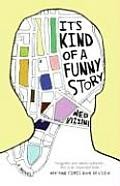
I had a chance to kind of observe the entire design process. I was even asked to submit a conceptual idea, which was a first for me. Together with the design team we came up with the little male/female pictograms. Where we went from there was all over the board. We discussed had four basic pictogram styles, one photographic cover (which was all shoes/feet), and then from there we discussed background colors, spacing, fonts – seven mock-ups later, we eventually decided that none of the designs worked for enough of us. Enter Number Seventeen Productions. They did some fun stuff with the designs for Ned Vizzini’s books (It's Kind of a Funny Story ), and I was eager to see what they had for me.


I was excited when I saw the cover – a pink pictogram with the stereotypical skirted girl figure, a blue pictogram for a stereotypical boy, overlapped… to create a purple one. And okay, your bubble can stay intact: for you, this cover is about family being a single unit.

For me, more than the obvious metaphor the figures represent, the cover hints about the self being comprised of more than we show on the surface; we identify in more ways than what we observe in others. We are both the sum of all of our parts, and more.

One thing I love about the characters you create, you never feel the need to prove their "Blackness", they simply are who they are.  Do you think your desire to simply tell great stories and not create characters that fit into a pre-assumed box has made it difficult for your work to be categorized? Or for you to find an audience?

Coe Booth was recently quoted in The Atlantic Wire’s piece, “The Ongoing Problem of Race in YA fiction” She talked about how authors of color are at times perceived to have some greater responsibility with their work, and that sometimes a book is … just a book. DEFINITELY, some people are automatically turned off by the covers of my books depicting people of color, definitely turned off by knowing that I am a person of color – there’s a lot of assumption about the types of stories a writer of color tells. However, I’m not sure it’s specifically down to not fitting into a pre-assumed box within writers of color -- it could always just be the way I write!

In grad school, an intense Latino woman cornered me one day and asked me why I wasn’t “representing” more, and really said some hard words about my community and my experience, and what I wasn’t doing right. I think of her from time to time, and hope that she understands that there’s no such thing as one experience and one community, for anyone of any gender, ethnicity, color or faith. If readers can remember that, they’ll find their choice of reading widens dramatically.

There's a real easiness to your writing that I like with the story always unfolding naturally from the dialogue to the situations. What do you think is the foundation of good writing?

Thank you. The foundation of good writing to me is intense, active listening, and close reading. The best writers have words swirling in their bloodstreams, and in their breath and bone. I encourage fledgling writers to read, read, read, and try their hand at expressing their world. Great stories flow from there.

The desire of the Nicholas family to find their happy again is something everyone can relate to. Do you think readers will be more accepting of differences after reading Happy Families?

I certainly hope so.  Ashley Hope Pérez wrote a blog essay - Happy Families is the antidote to the "I'm Christian unless"... disease, which resonated with me. She speaks eloquently on the message of this book for her, and people who were raised in conservative communities like her. She talks about the glossary in the back as kind of being the first step to an action plan – I can change the way I speak about this today. It is her belief that these faith communities will be better able to embrace this book than might be expected. I support her belief, and anticipate thoughtful action and support from those who wish to choose love over exclusion, and acceptance over mere tolerance.

Do you plan on doing any author events either in person or via Skype?

I’m currently in Scotland, and I’ve been here just shy of five years. In that time, Tech Boy has gone from Mr. to Dr. (he came to do one degree, and is leaving with two), and it’s time for us to leave. Far from being ready to “get back to normal,” whatever that is, I’m voting we go somewhere else adventurous, so stay tuned for where we end up! Meanwhile, I do Skype visits with Seton Hill University and Oakwood School almost every year. I’m interviewed by individual students and correspond with quite a few. People can contact me through my website.

I plan to be in the United States this summer, and while I haven’t got book things quite lined up just yet, keep an eye on my website and my blog – I’ll be around!

Be sure to check out the other Day 2 interviews. 

Timothy Decker @ Chasing Ray
Y.S. Lee @ The YA YA YAs

A comprehensive roundup of the tour

Monday, June 11, 2012

Nalo Hopkinson Interview (2012 Summer Blog Blast Tour)

Welcome to the first day of  2012 Summer Blog Blast Tour. This week eight bloggers will be sharing various interviews, all of which will be linked back to Chasing Ray.

Nalo Hopkinson is an award winning fantasy author, The Chaos her YA debut has received three starred reviews. I was very excited when I heard about this book back in December.  With there being so few YA fantasy authors of color, when an established one decides to write one, its a reason to cheer.
Hi Nalo and welcome. Can you tell us a little about The Chaos?
NH: Thanks for the welcome! Now, I suck at synopsizing my own work.Easiest for people to read the publisher's blurb. Basically, my protagonist, Sojourner "Scotch Bonnet" Smith, is a 16 year-old Toronto girl. Her nickname comes from the Jamaican scotch bonnet pepper, one of the hottest peppers in existence. Scotch is biracial. Her parents transferred her from one high school to another because she was being slut-shamed by the girls in her previous school. She's just broken up with her boyfriend although she still cares for him. She's also begun seeing things that no-one else can see, and there's something chasing her.

Why is Scotch self conscious about not having a Caribbean accent?
NH: Scotch's mother is black middle-class American, and her father is white working-class Jamaican. She's proud of what she is. People who have eyes to see can tell that she is black (though not everyone has eyes to see!). So she feels as though she's representing for the maternal part of her heritage. But no-one can see her Jamaicanness, i.e. her father's side of her heritage. She thinks it would be more obvious if she had a Jamaican accent. She also thinks it'd be something clear and simple that she could claim. Everything about her is so hybridized that although she's not ashamed of it, she doesn't have any easy markers of authenticity. She feels the pressure of that.

She doesn't have an easily definable identity, and that can make a person feel lost, like they don't belong anywhere, like they can't claim affiliation with any one group. Canada as a nation wrestles with what it means to be Canadian, so that comes into play a bit, too. It's most obvious in the scene in the bar where Scotch is scoffing at the MC who tries to seem more authentically black by talking in something like an American accent and by name-checking only black American musicians and musical stylings. It's a dilemma for many -- not all --young black Canadians as they try to self-define. On this continent, blackness is seen as synonymous with black Americanness. If they don't look and act like what people associate with American blackness, they get seen as weird, inauthentic.

After the Chaos everyone is changed in some way. What says more about a  person, the transformation or whether or not they are accepting of it?
I think it depends on the transformation and on the person. The woman who's now sprouting roses even though she's allergic to them might not be so sanguine about her new biology. And Scotch's change --i.e. the appearance of the creature that's stalking her -- she could be hurt.

 A rolling calf and Baba Yaga, are a part in the story. Caribbean and Russian folklore fusion was unexpected but works. Why did you decide to blend the two?
I'm glad that you think they work! I also invoked the firebird, the phoenix, the roc, the simurgh, the kappa, Anansi, Brer Rabbit, Tinkerbell, and Sasquatch. Others I just plain made up. People from the cultures all those mythologies are from live in Toronto, so it made sense to mix things up. Like Scotch's life, mine is also hybridized. It rarely makes sense for me to just pick one thing.

Beyond having an author of color pen a new YA fantasy, I was excited about your, YA debut because I knew it included a diverse cast including gay and lesbian characters. In your novels for the most part everyone is accepting of everyone else. Is this a true reflection of Canada or what you would like Canada to be?
I tried to mix it up; to show both acceptance and prejudice. Punum's dad kicked her out when she came out to him. Scotch's homophobia, classism and ableism peek through in a couple of places. She herself has to deal with people's racism. And almost everyone in her school is phobic about the three students who are in   relationship together. Toronto has a large population of lgbtiq people. I myself am queer-identified and have been blessed with the experience of having community in Toronto (communities of all kinds, actually). So I know what it's like to move in circles where the gender of the people you find attractive isn't necessarily an issue. It's not like that everywhere, even in Canada. So for me it's a healing balm to be able to bring some of that acceptance into my writing.

Do you see yourself writing another YA novel?
Yes, I can see myself writing more YA. In the time that I was writing The Chaos, I also completed my first YA novelette ("Ours Is the Prettiest", in the anthology "Welcome to Bordertown", edited by Ellen Kushner and Holly Black), and my first YA short story ("The Easthound", coming out in the anthology "After", edited by Ellen Datlow). I should point out that my first two novels, although I didn't write them specifically for young adults, were put on "Books for the Teen Age", the annual YA bibliography compiled by the YA librarians of the New York Public Library.

I like the meatiness that I'm seeing in YA, where authors are finding all kinds of creative ways to wrestle with issues that used to be verboten in YA, but that young adults face all the time. Some parents have been dismayed that in "The Chaos" my characters talk about sex and sexuality in the ways that many teenagers do. I sympathize. I went through a period of horripilations at the beginning of writing the novel as I tried to figure out how to tackle sex and sexuality. For me, it came down to this; I do think it's age-appropriate. We call them young _adult_ readers for a reason. Yes, they're young and relatively inexperienced and we want to protect them, but they're also growing up. They're thinking about and talking about and in many cases doing this stuff. I didn't put any explicit sex scenes in the book.

And my protagonist is sexually active, but not if the guy won't use a condom. Many sexually active teen girls are reluctant to insist on their own safety. She does insist on it. I haven't yet heard from any readers who think that the violence, homophobia, ableism and racism in the book aren't age-appropriate. But sex does make some readers balk. Thing is, if you're very conservative, you're probably not going to like my writing anyway. Literature is art, and one of the jobs of art is to shake you out of your comfort zone, make you think.

I really enjoyed The Chaos for its uniqueness, though it has polarized readers and critics. Are you surprised that there is no  middle ground, either you like it or don't response to The Chaos?

 A little, yes. I've expected it for other novels of mine, but no from this one. Some readers are put off because I don't explain the reasons for The Chaos. That was a deliberate decision on my part, though. A few readers have come to the conclusion that Scotch is troubled by being biracial. I see how they could read it that way, but in my mind, Scotch has no trouble with her racial heritages; it's other people who do, and who make her life difficult because of it. Some readers are put off by how much diversity and identity figure in the story, and some love it. That I expected. Some readers love that the novel has a secondary character of "invisible" (most days) disabilities, but I'm still figuring out ways I might approach the issue in my fiction. I think the character of Punum is my first significant try at it.

There are three more  Day 1 Interviews
Kate Milford @ Chasing Ray
Randa Abdel Fattah  @ Crazy Quilts
Tim Lebbon @ Little Willow

And once again a full round up  of all the interviews can always be found here.

Friday, February 3, 2012

Ashley Hope Perez Interview

Ashley Hope Perez's debut What Can't Wait was one of my favorite books last year and I am honored to be a part of her blog tour. Today I have the pleasure of hosting the author, as we talk about her newest release The Knife and the Butterfly. My review


Hi Ashley, can you tell us a little about The Knife and the Butterfly?

Of course! It follows two teens through the aftermath of a gang fight, but it also cuts back into what happened in their lives leading up to the day they met. Actually, I’m in awe of how well my publisher framed things, so here’s the jacket copy to get you all intrigued.

I must confess after reading the book blurb my first thought was “oh, no, a gang novel.” I was still going to read it but didn't have high hopes. I can say this all now because I've already read and really enjoyed The Knife and the Butterfly. I know it’s still early, but have you heard similar confessions?

Yours is the first confession, but I was very aware of how problematic writing about gangs can be. I didn’t want to glamorize or demonize Azael or his gang. MS-13 has been called “the deadliest gang,” and it’s definitely no joke. But at the same time, most of my research pointed to the fact that, in Houston at least, lots of youths involved with gangs like MS-13 are not highly organized or militarized like their counterparts in South America.

But this is not just an issue of veracity; it’s one of tone and balance. I think the reader learns how to filter Azael’s portrayal of his experiences, taking into account the bravado in his words when he describes his affiliation and past “accomplishments” with his gang. And I think the reader detects the sincerity in his desire to start anew and keep the people he loves clear of MS-13.

One of the first things I noticed is while Azael is in MS-13, he has the qualities of a leader and is not defined by his gang (even though he believes otherwise). How does this Azael compare to the Azael of the first draft?

Azael has pretty much been Azael since I first started imagining him. (Lexi was another story; she evolved a lot from draft to draft.) At first, I knew most about the Azael of the “Now” sections, and he could really piss me off (the way he thinks about women, for example). But I kept asking myself, who was he before he was this Azael? Where are the traces of those other selves, and what are the memories that he clings to—or that haunt him?

That process of discovery—and the boy I found under all the swagger—was what made me want to save Azael and give him the closest thing to a second chance that’s possible in his world.

Azael is a graffiti artist, using empty walls or trains throughout Houston as his canvas. Before you wrote the Knife and the Butterfly, what did you think of graffiti art (if you thought of it and all) And did your opinion change when you finished the novel?

I had noticed graffiti and spray-painted stuff in my environment while living in Houston, but I could never have told you the difference between a tag, a throw-up, and a piece. Nor would I have labeled myself a serious appreciator of street art.

I’m still firmly in the camp of “Don’t Mess Up Other People’s Stuff,” but as I learned about canning, I came to understand what making a mark on the city’s face might mean to a teen like Azael. The most powerful aspect of that discovery was that my own reasons for writing mapped pretty well onto Azael’s reasons for canning. Go figure. There is tons of graffiti inside the metro tunnels here in Paris, and as I commute, if I’m too tired to read, I watch it roll pass and try to imagine the need to be seen behind it.

Why did you decide use a real gang ?

A couple of reasons. The most obvious is that the novel was inspired by an actual event that involved MS-13. So I let reality take the lead in that respect. Going with MS-13 gave me a clear direction in my research: I knew I needed to learn about their hand signs, the “rules” of initiation and involvement, linguistic patterns, and so on. One reader living in Houston emailed me recently and described how, driving around, she kept thinking about “the other Houston” that the characters experienced. I don’t think you can get that kind of grounding with a fictional gang. At least, I don’t think I can do it. I like particularity.

There's an ease to your use of street vernacular (unlike some novels where it comes across has forced). Did your students give you any helpful feedback in regards to Azael’s slang?

Thanks for the compliment; I’m glad the language felt natural. I know there were kids in gangs at the high school where I taught, but I never knew who. Perhaps it was willful ignorance... I just didn’t feel equipped to deal with that knowledge. My students did tell me about the hostility between Salvadoran and Mexican-American immigrants. (Readers get a few tastes of this, like when Eddie complains about how “Mexicans never flush” their toilet paper or when Azael and Pájaro complain about Tejano music.)

I spent a lot of time reading first-person gang narratives and interviews with MS-13 members to pick up the right slang. Learning how street writers talk about their work (heaven spots, throw-ups, pieces, fat tips, skinny tips, buffing…) was another job.

Were there any words or phrases that you thought were current but were sadly dated?
It’s funny, it was actually kind of the opposite. I never would have thought to use the word “rumble,” for example, to describe a gang fight. To me, that word just screams The Outsiders and sounds totally forced. But it was all over the place in these interviews, so I learned how it fit into Azael’s speech.

Midway in, the reader is introduced Lexi, who like Azael finds herself thinking about past choices. What do you believe was harder for both characters, the remembering of deeds done or the actions themselves?

Definitely the remembering. Part of why Lexi and Azael struggle with what they’ve done is how little those past choices “weighed” when they made them. It scares me—and this is an inspiration for Azz and Lexi—that really bad decisions often don’t even feel like decisions. It can feel like something that “just happened.”

But we still have to own these actions, finally. This is a big theme in the book, which is probably why the rockstars at Carolrhoda Lab put this bit from Azael on the jacket:

“So I draw. I draw without worrying about what difference it’ll make; I draw because the pencil is in my hand. I draw, and I feel all the Azzs I’ve been, all my choices nested together inside me like the layers of an onion. My pencil is flying because that’s how it is: you choose and you choose and you choose, and that’s your life. That’s what you are.”

I really like the book cover and had a greater appreciation for it once I finished the story. Who was the cover artist?

The designers at my publisher are in charge of the cover work, but I don’t know which of the amazing artists came up with the exact design. I do know that the concept evolved considerably. Check out my guest post at Sarah Laurence's blog on for the inside scoop on the cover art and some of the designs that didn’t get chosen.

The cover is such important part of a novel and I love when I can learn more about it, so I can't wait to check that out.

I've enjoyed a few of your blog entries about living in Paris. After all the delicious food, your arrival post about adjusting to living in a new country is my favorite.

It's been a little over three months since you wrote that; does Paris feel less foreign yet?
Oh, absolutely. We feel like Paris pros now; we have our little routines and our familiar places. When we buy groceries, for example, it’s a whole ordeal, but it’s also a lot of fun. We have our baker, our chicken guy, our fish vendor, our salad and mushroom guy. Liam knows exactly who will give him a free banana or a slice of baguette. Sometimes I think about how weird it will be to return to the States and not get to buy all my groceries without ever getting into the car.

Some things are still mysterious to us, like the point of a strike if it’s announced weeks in advance, or why a government that prides itself on being rigidly secular still has Christian federal holidays. But we’ve learned not to lose sleep over these details.

Does your son know more Spanish, English or French words?

This question made me laugh out loud because the truth is that Liam knows more animal sounds than anything else. He is really good at them! He can do (in order of preference): dog, cow, lion, tiger, elephant, chicken, frog, owl, pig, monkey, sheep, and horse. My favorite is the lion because it comes with a paw swipe. The other day we were coming off the metro; usually, Liam waves bye to everyone, but this time he decided to ROAR! at everyone.

He does have words, too, and they are pretty balanced between the three languages. One thing that is fun to see how he’s already paying attention to who speaks what language. When he skypes with an English speaker, he says “bye-bye,” but when we leave his nursery school, he says, “au revoir.” When I leave the house, I usually get “adios.”

If you could have one thing imported from Houston to Paris for you, what would it be?

Oh, Lord. Just one thing? It would be a warm breakfast taco with a homemade tortilla, eggs, potato, cheese, and tomatillo salsa. Preferably from the Stripes gas station on Howard Drive. (I know that sounds gross, but they have ladies who make the most delicious food, and it’s right by where I used to teach.)

Do you plan on doing any Skype Q&A's for The Knife and the Butterfly?

I haven’t scheduled any yet, but I would love to! Book clubs, classes, the possibilities are endless! So anybody who’s interested should give me a holler.

Ashley, as you know the skype question was originally the last one. And it truly breaks my heart that this couldn't end there but I would be remiss not to mention Tuscon's recent decision to ban the Mexican American Studies Program and removing Latino related books from the classroom curriculum. I've been following Debbie Reese's excellent coverage and the more I read the less I understand. I am totally baffled as to how this could happen and the reasoning behind it.

Are you having any better luck processing this decision? Do you think or worry that Houston the city you call home would ever do the same?

I am still trying to wrap my brain around these actions. They are a blatant attack, not just on Mexican American Studies, but on a view of the world in which there are multiple stories that constitute a given history. The supporters of the house bill that ultimately justified the Tucson action (I have heard from some that Tucson resisted the shut-down; others seem to think they were thrilled to have an excuse to kill MAS) want to deny the complexity of the fabric that makes up the US. They are fine with curricula that "advocate ethnic solidarity instead of the treatment of pupils as individuals"--so long as the ethnic solidarity promoted is a sanitized version of whiteness, that is, itself, nothing but a myth. When the Irish came to this country, they were often treated in much the same way as recent brown immigrants. That, too, is part of our history. To teach it--or to teach about the oppressive treatment suffered by Mexican Americans and others--is not to incite dissent but to inform of fact.

We cannot address errors of the past by denying them; healing comes through broadened knowledge and dialogue, and the texts that have been recently removed from Tucson schools are powerful tools in that effort. That's why opponents are so keen on getting rid of them. But they know that that isn't enough; the truth is any text can be explored from an ethnic studies perspective (as the example from The Tempest demonstrates), so now district leaders are micromanaging the classroom practices of their teachers. That is scary stuff. I cannot imagine the same happening in HISD, where the success of the district depends on the success of Hispanic students, but who knows. At any rate, I know my teaching would wilt in such an environment, and I would have to think long and hard about what to do--how far to go in my resistance of censorship.

I want to make one last point to bring home the importance and relevance of ethnic studies for all of us. For my third novel, I have done a lot of research about the experiences of Mexican Americans in schools in the 1930s. What stunned me most in reading about the logistics of segregating Mexican-American students in Texas (and I bet the situation was similar in Arizona) was that they were essential forced out of school by sixth grade. Enormously overcrowded classrooms in the "Mexican" schools made learning difficult, putting the students further behind their white peers. On top of that, the school districts in Texas often divided elementary grades into two years ("lower first," "upper first") in "Mexican" schools, causing students to be told that they were "too old" for the grade they should have been able to join in the (white) middle school.

In Houston in the 30s, for example, only a handful of Mexican-Americans (usually lighter skinned) graduated from high school at all despite a significant Hispanic population in the area. They faced discrimination in white schools, and there was no "Mexican" public high school as an option.

I also discovered that, unlike African-Americans, whose teachers--also African-American--were usually committed to helping students use education to combat their circumstances, Mexican-American children were almost invariably taught by white teachers, some of whom found theirs an "undesirable" placement and were quick to underestimate the abilities of their students.
I couldn't have been more sympathetic to the challenges of my Mexican-American students, but--back when I was teaching in high school--I had NO IDEA that this was in our history. There is no way that you can tell me that these events--experienced by parents and grandparents of my students--had no impact on my students' own attitudes toward school. If I'd had the good fortune to take a class like the MAS courses recently axed in Tucson, maybe I would have been more informed.

These stories and experiences matter because they've shaped our shared history. We need to keep talking about them--in Tucson and beyond.

Thursday, July 14, 2011

Interview with Stacy Whitman (2011 SBBT, Day 5)

One thing I was really looking forward to this year was Tu Books, a new Lee and Low imprint that focuses on diversity for young readers in Fantasy, Science Fiction and Mystery genre. Stacy Whitman is the editorial director and founder of Tu Books. Even though Whitman's busy starting up a new imprint she still found the time to answer a few questions.

Hi, Stacy and welcome. Can you please tell us a little about your history in the publishing industry? And the beginnings of Tu Books?

Thanks! I am a farm girl, actually--grew up on a farm in Illinois raising horses and rabbits. Fast forwarding a bit, I got my master's in children's literature from Simmons College, and have worked at a newspaper, a trade magazine, an educational publisher, and Wizards of the Coast's Mirrorstone imprint for young readers, and was a freelancer when I started Tu Books

In 2009, as a result of the big #racefail discussion and while considering how we might be able to read books from Japan that hadn't been translated into English yet, a friend and I had an idea of filling a gap in children's and YA fantasy. We started playing with numbers, putting together a business plan--almost as a joke, though the more I looked at the numbers and the need, the more serious I became about it. My friend decided it wasn't for her, but I stayed with it, continuing to meet with our Small Business Administration counselor and starting a fundraiser on Kickstarter.com in hopes of raising enough money to approach a bank for a small business loan.

Meanwhile, at Lee & Low Books, they were considering how they might reach older readers, and when they saw all the excitement online that our Kickstarter campaign was attracting, publisher Jason Low got in touch and suggested that perhaps we might have similar goals. I joined Lee & Low early in 2010 and have been working on launching Tu ever since--our first books come out this fall!


I am a big fan of Lee & Low Books. How has the transition been after they acquired Tu?

Being with Lee & Low has been the perfect opportunity. Rather than having to create my own marketing, sales, and distribution plans and networks, Lee & Low already has a great reputation as a publisher of award-winning, diverse books for children. The people I work with get it, and their excitement to branch out into science fiction, fantasy, and mystery for older readers has been a huge support to me. And the best part of all, instead of the two books I'd initially been looking to publish in the first year, we plan for six books a year, with three our first season. I have all the support I need, including an intern who helps to read submissions, to enable me to make this work.

How big or small (since size is relative) is the Tu staff? And how diverse is it?

As you probably know, Lee & Low Books was founded by two Chinese American businessmen who saw that children's books needed more diversity. The company has been dedicated to diversity from day one. Our publisher, company president, and staff hail from a wide variety of ethnicities.

Tu's editorial staff is pretty small! I'm actually the only full-time editor, so being a white woman of Swedish-Irish-Scottish-English-German-Prussian descent, not much diversity there (I represent the farm-girl, rural perspective!). I have an intern who reads for me, freelancers who give feedback on manuscripts before acquisitions, and copyeditors and proofreaders who go over manuscripts before they're finalized in design. These women are from a variety of diverse backgrounds and their points of view are always helpful in asking questions I might have not thought to ask.

We also consult cultural experts to read manuscripts and give us feedback on blind spots we might be missing. Everyone at Lee & Low is dedicated to diversity in children's literature, so we all share a common mission both for Tu's books and for the Lee & Low and Bebop titles.

I love the covers of the three inaugural Tu titles, Tankborn by Karen Sandler, Wolf Mark by Joesph Bruchac and Galaxy Games by Greg R. Fishbone. The covers have a lot of eye appeal and fit the premise of their stories.

What is the cover process like? Do you use test groups?

Once the designer has read the book and I've given them suggestions from myself and the author, the process starts with the designer presenting me with sketches or mock-ups of cover concepts. If the cover is illustrated, of course, the artist might be involved with sketches. I run the concepts that I like most past several people in the office, including our publisher--who is very involved with Tu decision-making--and marketing people, and I consider all feedback.

Occasionally I might informally show a cover to a few teens with whom I work at a tutoring group in Harlem, but it's nothing official. It's nice to know, though, for example, that they all *loved* the cover of Tankborn. "That's a book that I would totally read," one said. That made me feel like we're on target. I've toyed with the idea of official test groups, and it may be something we'll consider in the future.

When will the Tankborn, Wolf Mark, and Galaxy Games be up on Tu Books website? Will excerpts be included? Where and when will Tu Books be available?

They're up now! Here are the links
Galaxy Games, Tankborn and Wolf Mark

And yes, there will be excerpts as well. All three books are available for pre-order at both Amazon and BN.com, and they'll be available in stores and online come September. They're listed as "out of stock" on the website right now, of course, because they won't be released until September, but once the release day arrives, you can order them online or find them in a bookstore near you.

The past few years there have been more middle grade and young adult fantasy novels with diverse cast. Though the number of authors of color writing fantasy is still very low. First things first, I want a good story. Period. Though I'd be lying if I said I didn't pay attention to how many middle grade and young adult authors of color are being published.

I've read some great novels with female leads written by men but I wouldn't want to be limited to female characters created by male authors. There is power in creation and everyone has a right to it.

Has Tu been doing anything to encourage authors of color to submit their work?

I've really been appreciating the recent uptick in diversity as well. Though of course the question is, are we doing much better now than we were twenty years ago? According to the CCBC, the actual numbers have held steady for over a decade. I'm glad to see more POC starring in their own stories rather than being relegated to sidekicks, but of course there's always more we could be doing. And you're right, part of doing better would be publishing more authors of color.

We've been working to reach out to a variety of writing societies for POC, such as the Carl Brandon Society, which is an African American science fiction and fantasy writers' society. I also try to encourage authors of color via calls for submission to general writing societies like SFWA and SCBWI, and in my talks on diversity at writing conferences--I try to address both encouraging authors of color to write fantasy/SF (or submit those manuscripts they might have put aside thinking there was no market for a POC main character in fantasy) and encouraging white writers to diversify their writing in a way that doesn't appropriate from other cultures.

Not to mention in my own personal networking on Twitter (@stacylwhitman), my blog, and so forth. But I'm also always looking for new places to send calls for submission, and would love suggestions for places I might have missed, particularly bloggers and online communities of writers that I might not know about.

Will Tu do its own version of the Lee and Low's New Voices Award?

I hope so! We haven't discussed it, but I think it's a good idea. We've just been focused on launching the actual imprint for now. Perhaps sometime in the future it could happen, but we don't have plans for it right now.

How does an editor edit cross-culturally?

Being an editor is kind of like being a lifelong student. You learn to look things up, to think about what you're reading critically, to figure out what you don't know and to ask questions. And there's a general awareness of diversity issues at play as I edit, things I've learned from talking about diversity issues with authors and readers online for several years and and from years of living with roommates from around the world and from different U.S. ethnicities. This awareness helps me have cultural perspective on a manuscript, to have a sort of rubric of questions I might ask a manuscript to meet in its own way (though each story is different). I try to get a sense of whether issues of privilege and racism are being played with in a way that enlightens rather than pains the reader (well, other than in ways that literarily *should* pain the reader, such as in a dystopia!). I hope I'm asking questions of authors that help them avoid pitfalls and blind spots.

But I don't think of myself as the expert--my role is to facilitate a good story and make sure that the cultural content works, up to the limits of my understanding, but I also rely on authors to have done their research and/or to speak from personal experience in their own culture. I also, as noted above, rely on cultural experts to help us fill in the gaps where the author's research might have fallen short, especially for writers who are writing cross-culturally, who may miss nuances even if they've lived in a culture as a Guest (see Nisi Shawl's excellent article delineating the theory of Invaders, Tourists, and Guests here.

If I'm an expert at anything, I hope it's an expert at asking questions that the author can translate into crafting a better book.

How has Tu Books reception been?

At ALA last month in New Orleans (the American Library Association annual conference), and the reception from librarians, I'm told, was *wonderful*. People were so excited about it--both people who knew Lee & Low and were excited for the expansion, and people who love fantasy and science fiction and were excited about the diversity of characters and stories. I'm starting to see reviews online of the ARCs that were given out at Armchair BEA, as well, and so far I'm seeing so many positive things. It's reaffirming.

Many people got behind Tu before it was acquired by Lee and Low, proving that diversity is needed and wanted. What can people do to help Tu become a viable imprint?

Keep an eye out for our books this fall. Ask your local independent bookstore to consider stocking our books, and support them by buying books from them. And if you got an ARC, please consider posting a review if you liked the books, even if it's just a mention in your Facebook profile. Any word of mouth will help! Tell all your friends about it! Ask your library to order our books for their shelves, and recommend that your friends check it out from the library if they can't afford to buy books. Suggest the books to teachers for whom the books might be appropriate--sometimes fantasy and science fiction is the best way to reach reluctant readers, and they might even find ways to use the books in the classroom that meet science, history, culture, or other standards.

Also, encourage writers of color to consider submitting to us if they have a book that might fit our mission.

And hey, young writers of color: Keep writing! We need your stories! As I read the other day--and I'm sorry I don't have an attribution for it--there have been societies who got along without the wheel, but there have never been societies who didn't have stories. What are your stories? What folklore, fairy tales, ghost stories, etc. can you draw upon for a fantasy story? Where will kids like you be in 100, 200, 400 years? What if a mystery happened in your neighborhood? There are so many possibilities, so many stories waiting to be told, and I look forward to reading them.

What if a teacher wants to order a class set?

All they'd need to do is to call our office see ordering information here on our website and ask for the Sales Department, who will be glad to assist you.

Stacy, Thanks so much for your time and goodluck with Tu Books

Be sure to check out the other Day 5 interviews

Genevieve Valentine @ Shaken & Stirred
Alyssa B. Sheinmel @ A Chair, A Fireplace & A Tea Cozy
Matthew Cody and Aaron Starmer @ Mother Reader

The full roundup of this weeks SBBT interviews is here

Wednesday, July 13, 2011

Interview with Ashley Hope Perez (2011 SBBT, Day 3)

When I started What Can't Wait, right away I knew the author was giving me much more then what I expected. It's a well told story that I couldn't help but love. I am very excited to have the opportunity to interview Ashley Hope Perez for the 2011 Summer Blog Blast Tour.


Hi, Ashley, Can you tell us a little about yourself? And What Can't Wait

Gladly! I’m a writer and reader first and foremost. This role currently plays out in lots of different ways—reading board books in Spanish with my one-year-old son, Liam Miguel, writing YA novels, working as a PhD student in comparative literature (newly ABD!), and teaching literature to undergrads. I L.O.V.E.teaching. I’ve worked with students in elementary bilingual programs and a Montessori school; I also taught high school English in Houston for three years. Now I teach college literature classes. I’m still in contact with many amazing students and committed to being an advocate for teens, especially young people for whom college is a new and foreign experience.

What Can’t Wait is about Marisa Moreno, a bright teen who has to figure out
what to do with her future—and how to do it when everyone in her family hasother ideas for her. What Can’t Wait is the novel my students in Houston asked for—one that was hopeful but that didn’t sugarcoat their experiences. Meet some of my students here.

From the beginning Marisa's voice and family dynamic are on full display. Did you think it was important for readers to connect with Marisa early on?

Every writer wants readers to connect to her characters early and deeply. The difference in What Can’t Wait, though, is that Marisa’s family is much more present and prominent from the start, whereas in many YA novels, family is more background than core to the story. Marisa’s parents, siblings, and niece are often a source of challenge and frustration that drive the plot, but they also can be a surprising (if inconsistent) source of support and inspiration. One of my big goals with the book was to explore how dramatically my students’ lives and prospects were intertwined with those of their families.

I loved the fact that Marisa wasn't waiting to be saved and there wasn't an adult there to make every okay. Marisa's AP calculus teacher was nice and supportive but couldn't fully grasp her family’s situation.

Did the calculus teacher's role in Marisa life change as the story developed?

I definitely wanted to avoid the “teacher steps in and saves the day” trope, so as I was writing, I found myself paying attention both to how Marisa’s teacher could be a facilitator of her success and an additional source of frustration. There was definitely some back and forth as I explored that relationship.

And as far as not grasping Marisa’s situation, Ms. Ford is totally me during my first year of teaching (of course, I was teaching English, not math). There were many, many times that I failed to ask my students what was going on in their lives so that we could figure out how they could take care of urgent needs and accomplish ambitious learning goals.

The machismo of Marisa's father further complicates her family obligations. If Marisa's older brother, Gustavo, had college aspirations do you think the father would've been okay with that?

Hmm. It’s hard to say. The father might have objected, but I think it would have been easier for Gustavo to defy their father without causing an explosive reaction. In a household like Marisa’s, there’s an unspoken rule where by young adult males are relatively free to do as the please where as young women—even once they graduate—are still seen as under their parents’ (or their father’s)control.

I've read several places that you wrote What Can't Wait for your students. Did you let any of them read early drafts?

If so what was one critique that helped make the story even better?

Many of my students read and commented on the draft. One of my students actually came to a book signing with a copy of the original manuscript I gave her to read. She had saved it for four years.

I wish now that I had had as much foresight; I would love to have all the sticky notes my students gave me with their reactions to particular scenes. One piece of feedback I remember was that Alan should be good but not too good—that he still needed to be human.

I loved Marissa and Alan together. Both had a grounded human, not perfect quailty about them.

Before What Can't Wait was acquired by Carolrhoda Books, what type of responses or feedback did you receive from other publishers?

While my agent was shopping the novel around, he did send the responses onto me, but this is the kind of thing that you pretty much scrub from your brain once you do get a book deal. From what I remember, the responses pretty much boiled down to different versions of “there’s something strong here, but it’s not for us.”

Sometimes that was because the editor felt that the book would be competing with one she already had on her list. Other times the response was more idiosyncratic, as with one editor who felt the portrayal of Marisa’s family was too harsh compared to her sense of the Latino community.

For the record, one of the most frustrating responses to What Can’t Wait is this “but that’s not what Latino life is really like” reaction. Of course Marisa’s family doesn’t stand for all Latino experience, but neither is it outside the realm of what some of my students lived with. Marisa’s family is her family, plain and simple, and every family has its own quirks and demons. I guess it irks me mostof all because no one expects the home life of one white protag to stand for all Caucasians. I’m grateful that this reaction is relatively rare.

When you started your novel did you realize how underrepresented YA Latino authors were?

Yes and no. Because I started writing YA while I was still teaching high-school English, what I was most aware of was that there was a certain kind of book that my students wanted but weren’t finding. So I guess you could say I was first aware of a relative lack of diversity on the bookshelf. It wasn’t that there were no books about Latinos, but much of what was available didn’t resonate with my students. I wrote all about what it meant for me to tap into my students’experiences in this Diversity in YA post.

Name four must-read YA novels by Latino authors.


Only four?! How about 10? I absolutely love Ball Don’t Lie and MexicanWhiteBoy by Matt de la Peña; the voice in these novels is stunning, and I especially loved the grit and verve of Ball Don’t Lie. Alisa Valdes-Rodriguez’s Haters is lighter fare—chick lit with a paranormal twist and some hilarious characters. Benjamin Alire-Sáenz’s Sammy and Juliana in Hollywood is also a wonderful read. And although I haven’t read it yet, I’ve been dying to check out René Saldaña’s new novel, A Good Long Way.

For slightly younger readers, I love The Circuit by Francisco Jiménez and Trino’s Choice by Diane Gonzales Bertrand.

And to finish off with three top recommendations of books by Latino authors that aren’t actually marketed as YA but would appeal to teens: Ana Castillo’s experimental novel, The Mixquiahuala Letters; Cristina Garcia’s Dreaming in Cuban; and Tomás Rivera’s And the Earth Did Not Devour Him.

You've taught an undergraduate vampire literature class and one on WomenWriters of the Caribbean. On a literary spectrum these classes have some serious distance between them.

What attracted you to both? And why do you love reading and teaching a wide range of fiction?

The class on Caribbean lit was one very close to my own reading interests, which is why I taught it. But I also like to design and teach courses that have surprises for me, too, which is why I decided to develop the vampire lit course. The idea came out of a conversation with some students about what kind of comparative literature course they wished they could take.

We decided that it would be worth going back to early vampire literature—starting with Goethe’s poem “The Bride of Corinth”—to develop an understanding of all the varied ways vampires can function in literature. We discovered a fascinating range of ways that vampires connected to sexuality, race, social protest, discourses on science and progress,and religion, to name just a few themes.

Can you tell us a little about your next novel, The Knife and the Butterfly?

While it’s also set in Houston, The Knife and the Butterfly plunges into an even grittier world than readers encounter in What Can’t Wait. It follows two teenagers through the aftermath of a deadly gang fight.

Lexi is a troubled girl from a working class background who hangs with a gang for protection. Azael is a romantic drifter who finds family in MS-13 after essentially being orphaned by his mom’s death and his dad’s deportation to El Salvador. Lexi and Azael live in a violent world governed by complex loyalties that land them in deeper trouble than they ever imagined possible. After the fight,they each must face the truth of what happened, and that truth eventually draws them together in a surprising yet powerful way

I wish I could tantalize you with one of the wonderful covers the design team at Carolrhoda has worked up, but they are still top-secret!

I love sneak peaks but rules are rules. Though I am glad you didn't stop at four. Ashley, thanks so much for your time and for writing one of my favorite YA debuts of the year.

Be sure to check out the other Day 3 interviews
Sarah Stevenson @Chasing Ray
Emily Howse @A Chair, A Fireplace & A Tea Cozy
Olugbemisola Rhuday-Perkovich @ Hip Writer Mama

The Full SBBT round up can always be found here

Tuesday, July 12, 2011

Interview with Neesha Meminger (2011 SBBT, Day 2)

The first time I heard about Jazz in Love, was after author B.A Binns mentioned getting Meminger's newest release at a conference. I went into google overdrive trying to find out more about Jazz in Love. I loved Jazz and her friends. When I finished I wanted to know about this self published novel that should've found a home.


Hi, Neesha and welcome. Can you tell us a little about Jazz in Love?

Jazz In Love is a story about 17-year-old Jasbir, a.k.a. Jazz, who loves reading romance novels and loves the idea of love and romance. The only problem is that, in her strict household, love are romance are not allowed--at least for Jazz. When Jazz is caught hugging a male friend good-bye, her parents freak out and set a guided dating plan in motion with the intention of finding Jazz an appropriate, *suitable* boyfriend who, they hope, will become her future husband. Of course, Jazz has other plans..

I loved Jazz's voice and I liked the fact that she wasn't struggling with her identity. Was this a conscious decision?

Yes. I wanted to tell the story of a South Asian teen who wasn't angsting about being different. She doesn't feel like an outsider, she's not confused about who she is, and she doesn't feel bad about herself in terms of her racial or ethnic identity. She's struggling with things like dating, beauty, her parents not understanding her, figuring out her friendships, figuring out guys, understanding her own budding sexuality...things that *all* teenagers are dealing with. But I wanted this particular story to have Jazz's unique fingerprint on it - it's a story that only Jazz can tell and there's nothing like it out there. That's what makes it unique, but also universal.

It's not often that I can visualize some of the secondary characters holding down their own story lines and becoming the main character. With Jazz in Love there are at least three.

If you could write a novel featuring one of these characters: Mit, Auntie Kinder, or Cindy, which one would it be and why? ( It took everything in me not to include Jeeves).

Ha! I actually would love to write Jeeves's story. He's such a great guy and I really wanted Jazz to end up with him. But she's not an easy gal to pin down and had ideas of her own. In terms of another character's story, I'm actually in the process of revising my next novel - a story about one of the secondary characters from Jazz in Love - it's going to be Pammi's story, Auntie Kinder's daughter. She has superpowers ;).

More Pammi is a very nice surprise and superpowers would be awesome. Jazz's (don't tell her parents) relationship with Tyler R. leads to an unexpected dark encounter.

Why does Jazz, a smart and well aware girl, try to rationalize Tyler R.'s actions in this situation?

I think far too many girls (and women, for that matter) make excuses for boys and men who sometimes exhibit questionable behaviour. Maybe these girls and women want to hold on to their idealized image of their boyfriend or partner, maybe they convince themselves to see the situation through their partner's eyes (in which case the partner's actions always make sense), maybe they just want to keep being "in love"... I don't know. I'm sure there are many answers, but I know that smart girls fall for shady/disrespectful/not-good-for-them partners *all* the time, and find ways to stay with them in spite of advice/warnings from family and friends.

Except for the whole guided dating plan, Jazz gets along very well with her parents. They're strict with high expectations but both seem very nice and don't come across as cruel (or give off a Tiger Mother vibe).

Having daughters of your own, do you relate more to Jazz or her parents?

Oy. This is a tough question. I relate to both, really. I remember, very well, what it was like to be a girl like Jazz. I remember having my first painful crush and not being able to share my feelings or questions or doubts or pain with *anyone*. And at the same time, I know what I know now after having lived through all those feelings and questions and doubts and pain, and made it through to the other side. I've learned some things.

Realized a lot about human nature and making decisions and facing consequences. And I've seen others who didn't make it as intact as I did. So I understand Jazz's parents, too. I understand their desire to protect their daughter and their desire to hold on to a language, and culture and traditions, they see slipping through their fingers.

So, a little of both - or a lot of both. With my own daughters, it's a mix of understanding what they're going through and guiding them through it; listening and helping without being overbearing; being firm when it's called for, but being gentle, too. It's a tough balance and it's about trust and having faith in your gut instincts. On both the parents' end *and* Jazz's end!

I love to laugh it out with fun YA. Unfortunately, it's not easy finding such books starring characters of color. So, I was pleasantly surprised to discover that Jazz in Love wasn't all serious and that there was a light and fun aspect to it as well.


A few months back I found the first two Bindi Babes books by Dhami at the library. I ran through that trilogy like candy.

What would it take to see a Jazz in Love sequel?

First of all, I LOVED the Bindi Babes books!! Those books by Narinder Dhami were part of the inspiration for Jazz in Love. I thought they were such fun and they contained cultural references that were specific to ME. Imagine that?! Actually seeing yourself in a mainstream representation?

I decided I wanted to do that, too. I wanted to write a story that would make teens of colour laugh and relate and delight in seeing themselves within the pages of a novel. So far, the response has been great :).

But to answer your question - when I first wrote Jazz in Love, I had two other books in mind: Jazz in India, and Jazz in College. I was all set to write them when Pammi's story just tore through me. I had to put everything aside to tell her story. I'm in the process of revising that tale now, but at some point I would love to get back to Jazz.

Jazz in love has been getting good blogger reviews. I am hoping that publishers are paying attention and will think twice before rejecting an author of colors works because it doesn't fit into their limited idea of what the market can handle.

How many houses did you submit Jazz in Love to before you said enough?

Thank you! I am thrilled with the reviews Jazz in Love has been getting. It was recently picked as a best YA selection by the Pennsylvania School Librarians' Association and was listed as a recommended summer read by Bookslut. I can't tell you how excited I was by those honours!

My agent and I sent Jazz out "widely" - which means it went to a lot of publishers. Sadly, that was in 2008, during the major crash in publishing and a lot of great novels fell through the cracks then. Jazz was one of them. And now, with publishers being so risk-averse and e-publishing taking off the way it has, things are really in flux in the publishing world.

Changes are happening so quickly and in such unpredictable directions, none of us can say for sure what's going to happen next. But I do hope that some of these changes allow more diverse voices to find their audiences and to "prove" that there is a vast and untapped readership out there for all kinds of stories.


I am bit jealous that you got to meet author Melina Marchetta. Have you had a chance to read her work ?

Melina is a warm and wonderful person with a crapload of talent. Looking For Alibrandi has to be one of my absolute favourites.

Will you have time to watch the new season So You Think You Can Dance ? I know your a fan.

I am so watching it right now

Where can people buy Jazz in Love? What if a teacher wants a classroom set?

People can buy Jazz in Love at any online retailer, or they can order it through their favourite local bookseller. It's also available as an ebook through Smashwords, Kindle, Barnes & Noble, the Apple iPad store and anywhere else ebooks are sold. And I am currently working on the audio book for both Jazz in Love and Shine, Coconut Moon.

If a teacher wants a classroom set, s/he may contact me directly, or order through Ingram or Baker & Taylor. They could also go through their bookseller of choice.


Neesha, thanks so much for your time and another great novel.

Be Sure to Check out the other Day 2 Interviews

Sean Beaudoin @Chasing Ray

Rachel Karns @ Bildungsroman